

Walk into any Tibetan monastery and you will encounter them — arranged on altars, carried by monks, rung at the opening of ceremonies, spun by practitioners walking the outer courtyard. These are not decorations. They are instruments of awakening.
The Eight Sacred Ritual Objects of Tibetan Buddhism represent eight dimensions of spiritual practice — eight ways that the physical world becomes a doorway to the sacred. Each object has its own history, its own symbolism, its own sound, weight, and presence.
This is their story.
1. Vajra Bell (Drilbu) - The Voice of Wisdom
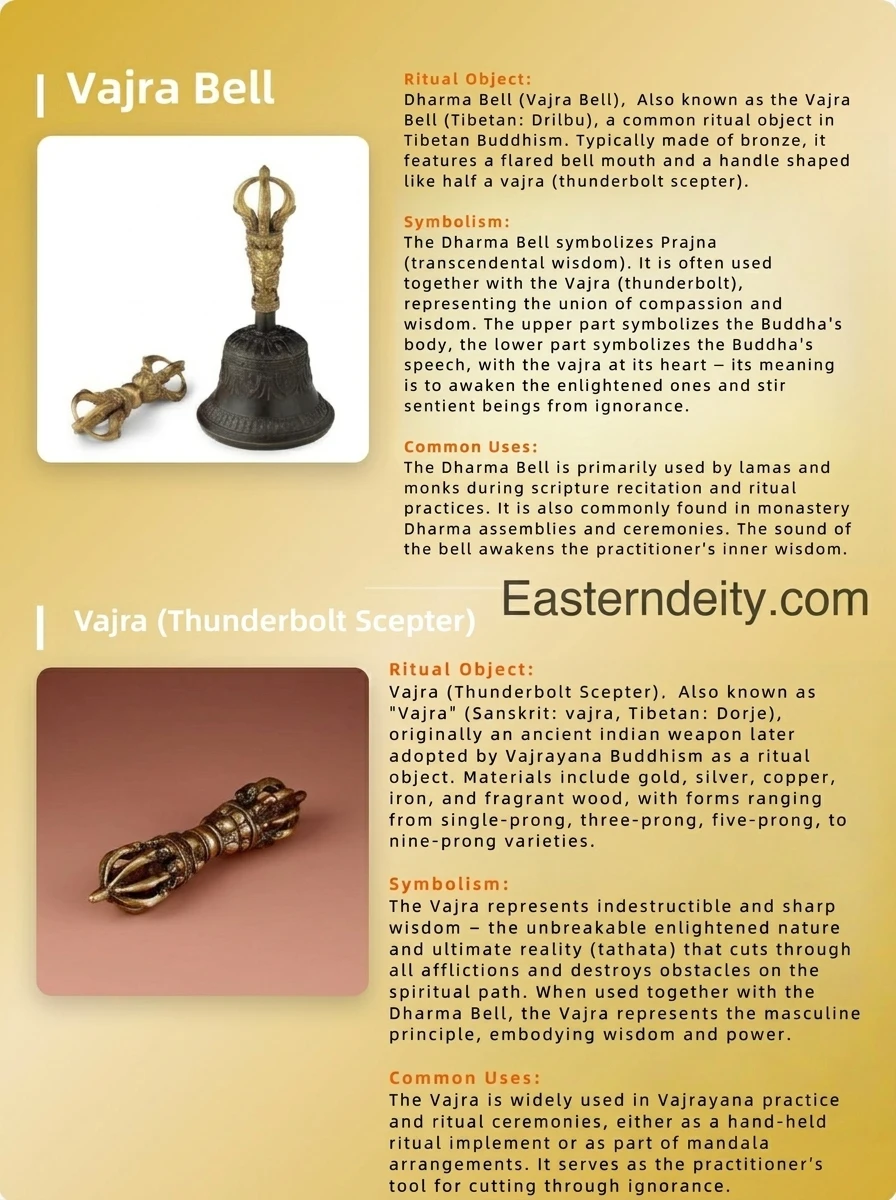
Of all the ritual objects in Tibetan Buddhism, none is more fundamental than the Vajra Bell — known in Tibetan as Drilbu.
The bell is always paired with the Vajra (thunderbolt scepter). Together, they represent one of the deepest teachings in the tradition: the union of wisdom and compassion, of emptiness and form, of the feminine and masculine principles of enlightened reality.
The bell itself is a masterpiece of symbolic design. Its upper section represents the body of the Buddha. Its lower section — the flared mouth — represents the Buddha's speech. At its heart, embedded in the handle, is a half-vajra: the seed of indestructible awareness.
When a Lama rings the Dharma Bell during practice, the sound is not merely beautiful. It is a call — to the practitioner's own dormant wisdom, to the deities being invoked, to the sentient beings who might hear and be moved toward liberation.
The bell awakens. That is its only purpose. That is enough.
2. Vajra (Thunderbolt Scepter) - Indestructible Wisdom
The Vajra — Sanskrit for "thunderbolt" or "diamond," Tibetan Dorje — began its life as a weapon. In ancient Indian mythology, it was the thunderbolt of Indra, king of the gods: a weapon of absolute, irresistible power.
Vajrayana Buddhism transformed this weapon into something more precise and more devastating than any physical force: a symbol of the indestructible nature of enlightened awareness.
The Vajra cuts through ignorance the way a diamond cuts through lesser stone. It cannot be destroyed, dulled, or deflected. It represents tathata — the ultimate reality that underlies all appearances — and the enlightened mind that recognizes it directly.
Vajras are made from gold, silver, copper, iron, or sacred wood. They come in single-prong, three-prong, five-prong, and nine-prong forms, each corresponding to different tantric practices and deity systems.
Held in the right hand during ritual, paired with the bell in the left, the Vajra is the practitioner's declaration: I am working with the most fundamental reality there is.
3. Dharma Drum - The Sound That Shakes the World
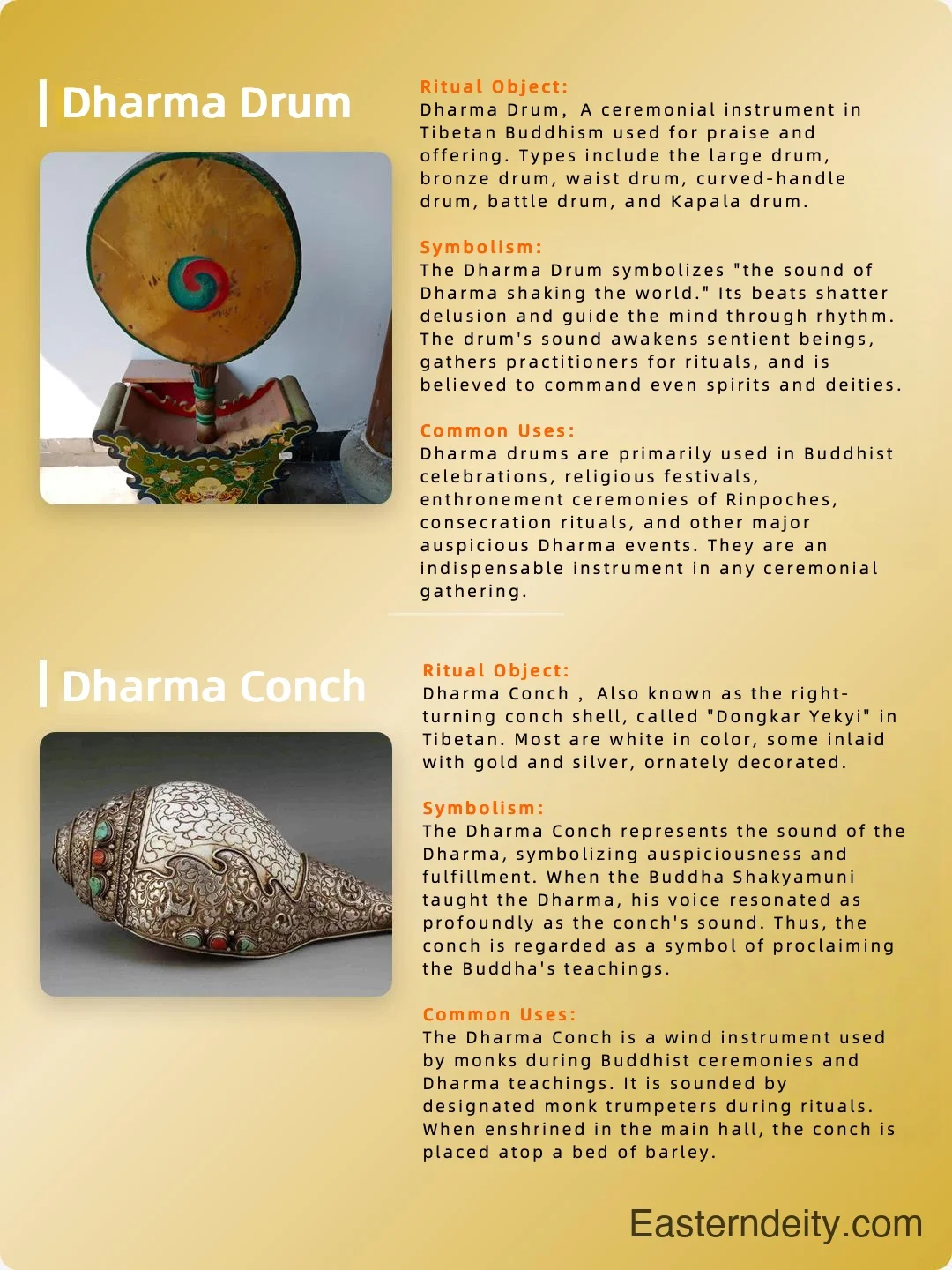
The Tibetan Dharma Drum carries a teaching in its very name. In the Buddhist texts, the teachings of the Buddha are described as "the sound of the Dharma shaking the world" — a sound so profound it reaches beings in all realms of existence.
The drum makes that metaphor physical.
When a Dharma Drum sounds in a ceremony, something shifts. The rhythm cuts through mental distraction. The resonance moves through the body before the mind has time to process it. Ancient practitioners understood that certain sounds bypass conceptual thinking entirely — they speak directly to something deeper.
Types of Dharma Drums include the large ceremonial drum used in major festivals, the bronze drum, the waist drum, the curved-handle drum used in processions, and the Kapala drum — made from human skull — used in advanced tantric practice as a reminder of impermanence.
The drum gathers practitioners for ritual. It marks the opening and closing of ceremonies. It is believed to be audible to beings across all realms — a call that transcends the boundary between the visible and invisible worlds.
4. Dharma Conch (Dungkar) - The First Sound
Before recorded history, before written language, before the first monastery was built in the Himalayan highlands, human beings were already listening to the sound of the conch shell.
In Tibetan Buddhism, the Dharma Conch — Dungkar in Tibetan, specifically the right-turning white conch — carries extraordinary significance. When the Buddha Shakyamuni first turned the Wheel of Dharma, his voice was said to resonate as profoundly and as far as the sound of the conch. The conch became, therefore, a symbol of the Dharma itself — of teachings that spread in all directions, reaching all who are ready to hear.
Most Dharma Conches are white — the color of purity and auspiciousness. The finest are inlaid with gold and silver, ornately decorated with sacred symbols. They are placed atop beds of barley when enshrined on altars, supported by the earth's abundance as they proclaim the teachings of liberation.
When the conch is blown at the opening of a ceremony, it is not simply a signal. It is an announcement — that the sacred is about to be invoked, that the boundary between ordinary and extraordinary time is about to be crossed.
5. Prayer Beads (Mala) - 108 Knots of Attention
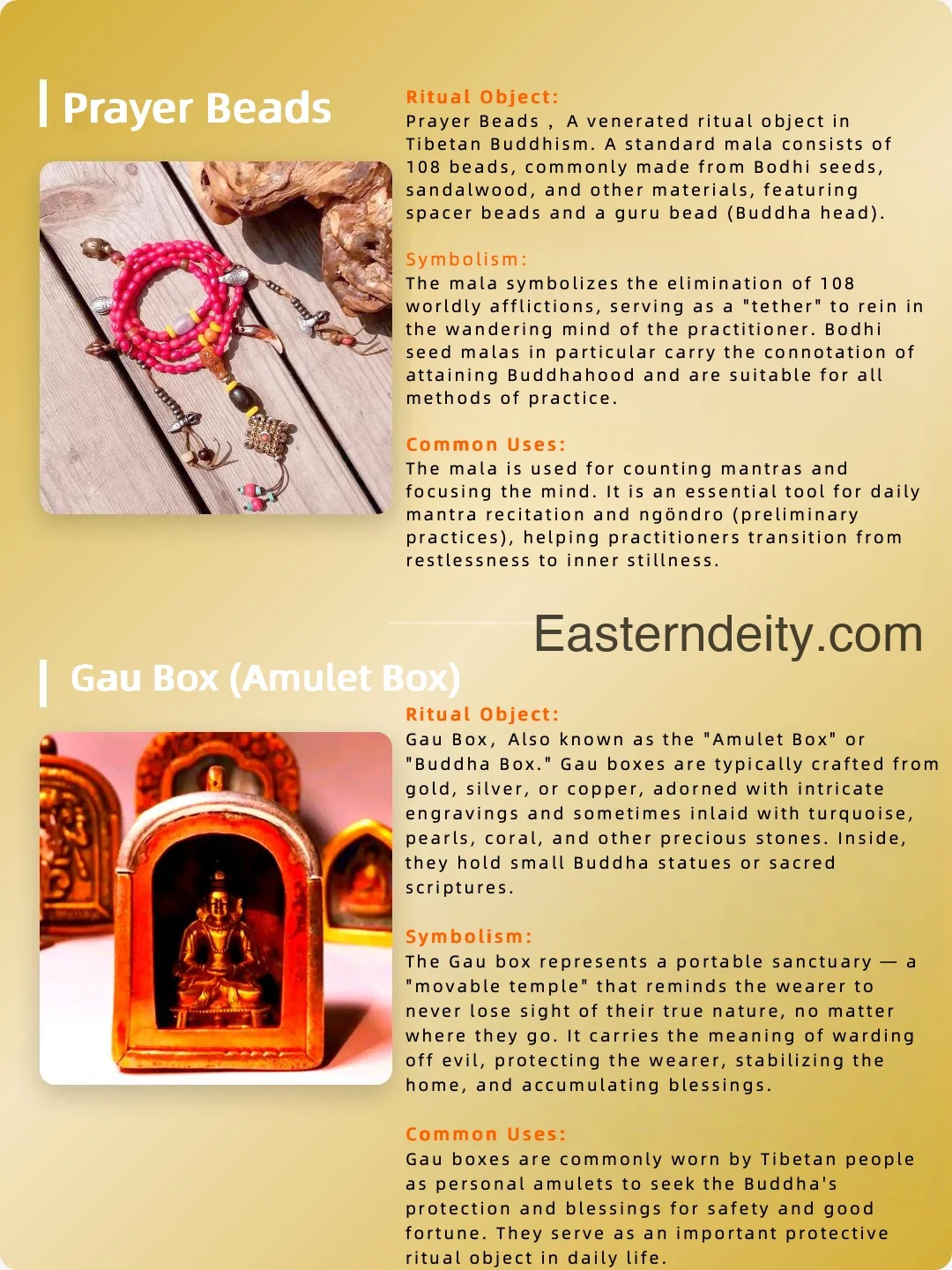
The mala — the Tibetan Buddhist prayer bead string — is perhaps the most intimate of all the eight sacred objects. Where the drum and conch fill vast ceremonial spaces, the mala lives in the hand. It is worn against the skin. It is a constant companion.
A standard mala consists of 108 beads — the number representing the 108 worldly afflictions that Buddhist practice aims to eliminate. Made from Bodhi seeds (the most sacred), sandalwood, lotus seeds, crystal, or gemstones, each mala also includes spacer beads and a guru bead — the "Buddha head" — which marks the beginning and end of each full rotation.
The mala is used for counting mantras. Each bead is one recitation — one rotation of the syllables that, in the Vajrayana understanding, carry the living energy of the deity they invoke. The most common mantra counted on a mala is Om Mani Padme Hum — the mantra of Avalokiteshvara, the Buddha of Compassion.
But the mala is more than a counting tool. It is a tether — something that keeps the wandering mind anchored to practice. Each time the fingers move to the next bead, there is a moment of return. A moment of presence. Multiplied 108 times. Multiplied across years of practice.
This is how awakening happens — not in a single dramatic moment, but bead by bead, breath by breath, return by return.
6. Gau Box (Amulet Box) - A Temple You Can Carry
The Gau box — also known as the Amulet Box or Buddha Box — solves a problem that practitioners have always faced: how to carry the sacred with you when you leave the monastery, when you travel, when you move through the ordinary world.
The answer: you build a temple small enough to wear.
Gau boxes are crafted from gold, silver, or copper — metals of spiritual conductivity. Their surfaces are covered in intricate engravings: lotus flowers, auspicious symbols, deity figures, mantras worked in metalwork so fine it requires a magnifying glass to appreciate fully. The finest are inlaid with turquoise, coral, pearls, and precious stones — materials that carry their own energetic significance in the Himalayan tradition.
Inside each Gau box lives a small Buddha statue or a tightly folded sacred scripture — the heart of the object, protected by the outer shrine, carried close to the body of the practitioner.
Wherever you go — across mountains, across oceans, across the uncertainties of life — your temple comes with you.
7. Prayer Wheel (Mani Wheel) - Every Turn, a Prayer
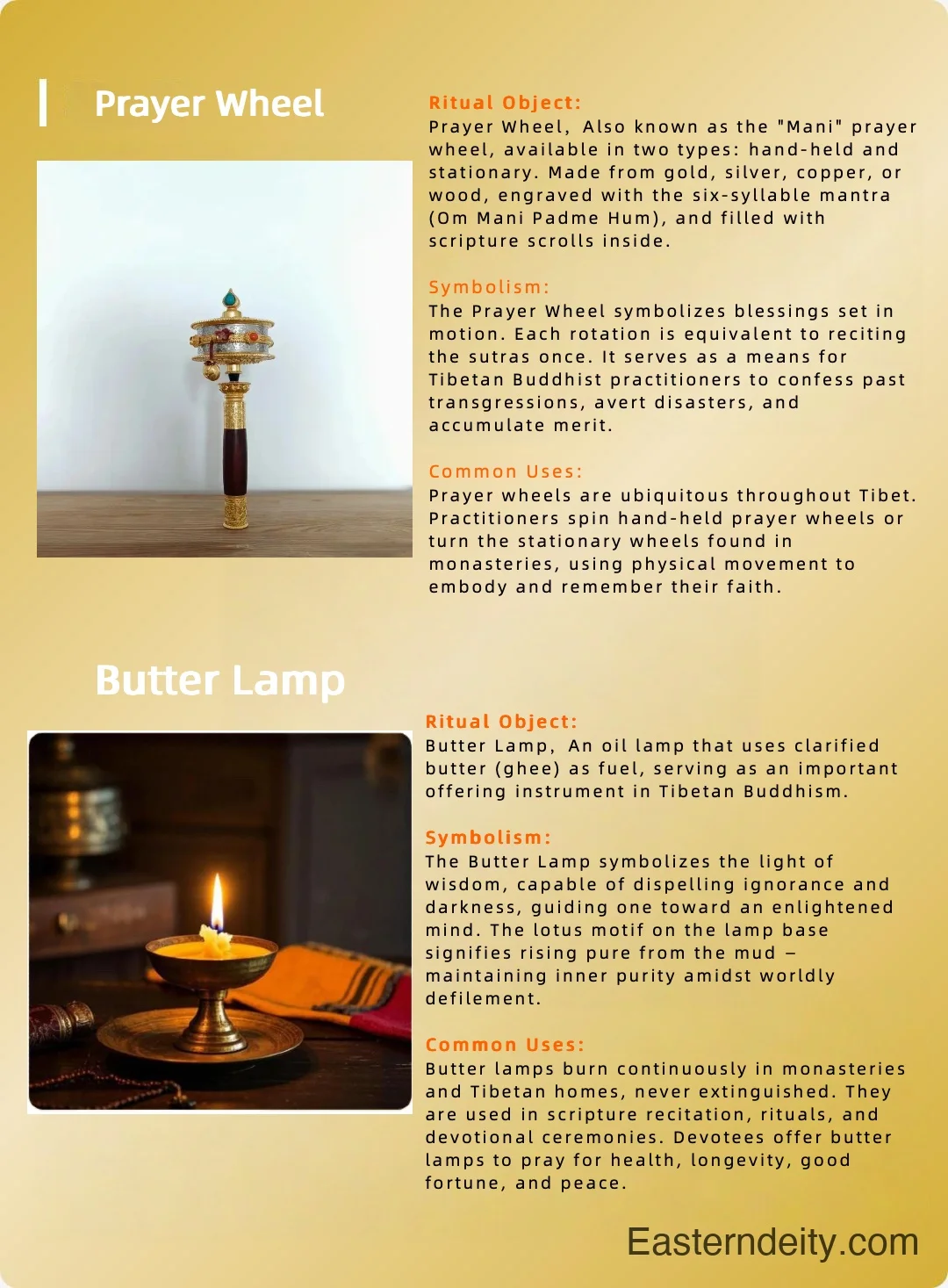
The Prayer Wheel — Mani Chos Khor in Tibetan — is one of the most distinctive of all Tibetan Buddhist objects. Inside every prayer wheel is a tightly wound scroll containing the mantra Om Mani Padme Hum, written thousands or even millions of times. According to the tradition, each rotation of the wheel is equivalent to reciting the mantra once for every inscription it contains.
Prayer wheels come in two forms: hand-held, spun by individual practitioners as they walk; and stationary, built into the walls of monasteries and temples, turned by all who pass. Throughout Tibet, turning prayer wheels is as natural and as constant as breathing.
Each turn is a prayer. Each prayer reaches outward — to the practitioner, to those nearby, to all beings everywhere.
8. Butter Lamp (Choeme) - The Light That Does Not Go Out
The Butter Lamp — Choeme in Tibetan — burns clarified butter (ghee) as its fuel. It has burned continuously in Tibetan monasteries for over a thousand years. In the great monastery halls of Tibet, hundreds of butter lamps burn at all times — their flames never extinguished, their light never interrupted.
The Butter Lamp represents wisdom. Its light dispels the darkness of ignorance. Its flame — steady, warm, reaching upward — is the mind that has recognized its own luminous nature and can no longer be fully extinguished by confusion or suffering.
Butter lamps are offered to pray for health, longevity, good fortune, and peace. They are offered for the benefit of those who have died — to guide consciousness through the unclear passages of transition. They burn for the living and for those who have moved beyond living.
They burn because the light matters. Because even a single flame changes the nature of the darkness around it.
Closing - The Eight as One
These eight objects do not exist in isolation. They form a complete system — a technology of awakening that works on every level of human experience simultaneously.
The sound of the bell and drum works on the auditory nervous system — cutting through distraction, opening attention. The visual presence of the Vajra and Gau box works on the visual and tactile — anchoring awareness in the physical world while pointing beyond it. The rhythm of the mala and prayer wheel works on the kinesthetic — keeping the body engaged so the mind cannot wander. The light of the butter lamp and the sound of the conch work on the most primal levels of human consciousness.
Experienced together — as they are in a Tibetan monastery during a major ceremony — they create an environment in which ordinary consciousness simply cannot maintain its usual contracted, distracted state.
This is the genius of the tradition. It does not ask you to think your way to awakening. It builds an environment in which awakening becomes the natural response.
The objects are ready. The environment is prepared. What happens next depends on you.
Each of the sacred objects described in this article is available through Eastern Deity — sourced directly from Himalayan artisans and, where applicable, consecrated through traditional ceremony before being offered to you.
Explore our collection at easterndeity.com
0 comments